
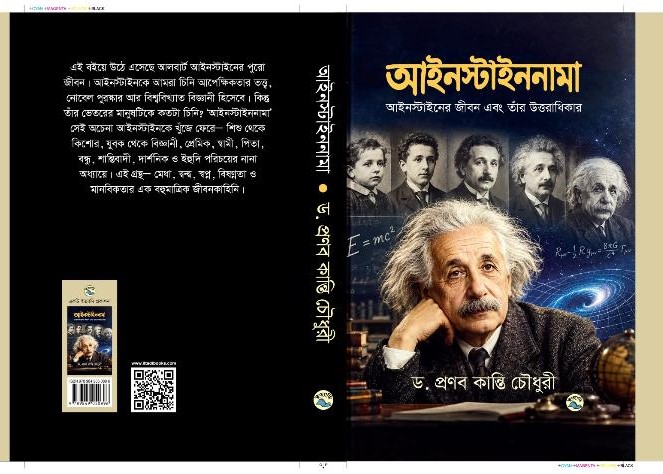
Einsteinnama: Einstein’s Life and His Legacy by Dr. Pronab K. Chowdhury is a comprehensive critical biography and sociological analysis that seeks to deconstruct the “myth” and “cult of personality” surrounding Albert Einstein. Rather than celebrating Einstein as an untouchable icon of genius and humanism, the book applies the author’s scientific framework of Evolutionary Anthropodynamics to examine Einstein’s personal failures, scientific limitations, political involvements, and legacy.
1. Core Thesis and The “Bottom-Up” Approach
The author contrasts traditional biographies—which use a “top-to-bottom” approach by starting with Einstein’s world fame and fitting his early life around that legend—with a “bottom-to-top” approach. By chronicling Einstein’s life chronologically across 20 chapters, Chowdhury analyzes how specific events, personal ambitions, and social forces transformed Einstein from a natural, secular “truth-seeker” into a commercialized and political brand:
- Chapters 1–3 (Education & Youth): Examines his upbringing in an Ashkenazi Jewish family, arguing that historical evidence for his childhood “prodigy” status is thin compared to titans like Sir Isaac Newton or James Clerk Maxwell.
- Chapters 4–6 (Scientific Achievements & Re-evaluation): Assesses his 1905 “Miracle Year” papers as derivative recombinations of work by Lorentz, Poincaré, Planck, and Boltzmann rather than entirely original leaps. Chowdhury characterizes General Relativity as a “Makal fruit” (gvKvj dj)—mathematically elaborate but practically empty and disconnected from the major physics breakthrough of the era, atomic structure.
- Chapters 7–9 (Creative Decline & “Einstein’s Dream”): Traces Einstein’s post-1919 stagnation. It highlights his dogmatic crusade against Quantum Mechanics (“God does not play dice”) and describes his decades-long pursuit of a Unified Field Theory as a media-hyped “hoax” used to maintain his celebrity status.
- Chapters 10–13 (Domestic & Personal Critique): Critiques Einstein’s personal ethics, focusing on his harsh treatment of his first wife Mileva Marić, the abandonment of their secret daughter Lieserl, his neglect of his sons Hans Albert and Eduard, and numerous extramarital affairs.
- Chapters 14–17 (Politics, Philosophy & Pacifism): Evaluates his political choices, including his 1939 letter to President Roosevelt sponsoring nuclear weapons, which Chowdhury attributes to inherited ethnic German animosity. It also critiques his philosophical depth, referencing his 1930 debate with Rabindranath Tagore and his failure to defend Baruch Spinoza’s memory against excommunication.
- Chapters 18–20 (Zionism, “IQ Supremacy” & Empire): Details Einstein’s 1914 embrace of Jewish tribal identity, the 1921 American fundraising tour with Chaim Weizmann, and his transformation into a global asset for the Zionist movement.
2. Scientific Foundation: Evolutionary Anthropodynamics (UMNE)
A central feature of the book is its grounding in the Unified Model of Natural Evolution (UMNE) and its sociological branch, Evolutionary Anthropodynamics:
- Four Stages of Evolution: The universe evolves through the Planckian (space-time), Einsteinian (matter-energy), Darwinian (biological life), and Intellectual (human culture/society) stages.
- Life Symmetries (LS1–LS8) & Intellectual Fields (IF): Human consciousness and social structures are governed by eight life symmetries (such as identity, social status, democratic, and ideological symmetries).
- Social Stratification & Population Types: Societies consist of different intellectual strata (Buffer, Body, Filter, Driver). Chowdhury categorizes specialized populations like HIIHIQ (High Intellectual Index, High IQ)—the cognitive elite of the secular Jewish diaspora—and LIIHIQ (corporate technocratic elite).
- The 75-Year Rule: The book posits a mathematical rule of social dynamics stating that anti-evolutionary or extreme social systems reach a terminal breaking point approximately 75 years (three generational cycles) after inception, applying this to the German Empire (1871–1945), Soviet Communism (1917–1991), and modern geopolitical constructs.
3. Key Conceptual Themes
- The “Einstein Pill”: Defined as an “intellectual hypnotic effect” created by media campaigns to condition the public into treating Einstein as the ultimate symbol of genius. This effect is used by elites to justify political, technical, and tribal objectives as the natural outcome of superior intelligence.
- The “IQ Supremacy Empire”: The author argues that Einstein’s rise was leveraged to build a borderless technocratic empire governed by high-IQ elites (such as the “Davos Elites”), replacing traditional land-based colonial dominance with a system based on intellectual and technological control.
- Sapiens Powered Evolutionary Explosion (SPEE): Major historical catastrophes, such as the Holocaust, are analyzed as terminal “evolutionary bombs” or crises resulting from severe cultural and political instability between conflicting populations.
Summary Conclusion
Ultimately, Einsteinnama presents Albert Einstein not as an isolated, saintly genius, but as a complex historical figure whose extraordinary fame was forged at the intersection of early 20th-century physics, intense media promotion, and geopolitical agendas. Through the lens of Evolutionary Anthropodynamics, Dr. Chowdhury argues that understanding the true legacy of Einstein requires stripping away the manufactured myth to examine his real scientific, personal, and political impact on modern civilization.
Comment : AI(Gemini ) generated notes on the book ‘Einsteinnama : Einstein’s Life and His Legacy ‘ by Pronab K Chowdhury


Leave a Reply