
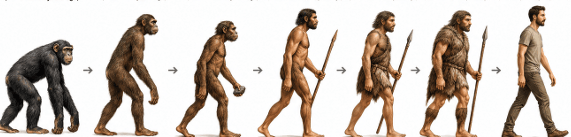
In the source material, Evolutionary Anthropodynamics is a mathematical and scientific framework developed by Dr. Pronab K. Chowdhury to describe the cultural and intellectual
evolution of human society 1. It is the fourth and final stage of a broader model called the Unified Model of Natural Evolution (UMNE), which tracks evolution from the Planckian scale
to Ro-material (Einsteinian), to biological life (Darwinian), and finally to human intellectual systems 1-3.
The framework analyzes human history and social structures using the following core components:
- Cultural Populations and Intellectual Systems
The framework views human society not merely as a collection of individuals, but as a series of cultural populations or intellectual systems 4, 5. Every population possesses an Intellectual Index (II), which acts as its “genotype” or internal intellectual distribution 4, 6. - Professional Distributions (The “Phenotype”)
A population’s interaction with its environment creates a “phenotype” known as its Professional Distribution 7. Members are categorized into three functional groups:
● Intellectual Professionals (r): Natural truth-seekers (e.g., scientists, philosophers) 8, 9.
● Intelligent Professionals (q): Strategic and goal-oriented experts (e.g., politicians, corporate leaders) 8-10.
● Ordinary Professionals (p): The general working population (e.g., laborers, farmers) 7, - The Structure of an Intellectual System
The author models an intellectual system similarly to a physical system, consisting of four parts:
● Driver: Composed of “hyper-intellectuals” (IL7 and IL8 tiers) who acquire new knowledge 6, 11.
● Filter: Translates high-level knowledge into social ideologies 6, 11.
● Body: The main population (tiers IL3 to IL6) 11, 12.
● Buffer: The lower cognitive tiers (IL1 and IL2) 12. - Fields and Symmetries
The framework utilizes specific variables to measure social consciousness and interaction:
● Intellectual Fields (IF): These are fields of consciousness ranging from self-awareness (IF1) to the unity of nature (IF7) 13, 14.
● Life Symmetries (LS): These represent different levels of evolutionary identity, such as ethnic (LS3), social status (LS4), or ideological (LS6) 13, 15.
● Intellectual Temperature ($\eta$): This is the “mean effective intellectual index” of a population, which determines its evolutionary stability 16, 17. - Evolutionary Stability and the “75-Year Rule”
A central tenet of the framework is Evolutionary Stability, which posits that stable populations must follow specific ratios of professional groups (p > q > r) 7.8. If a population undergoes an “anti-evolutionary process” or a major ideological shift, the framework applies the 75-year rule,
which calculates that it takes approximately three generations (75 years) for a system to reach
its terminal breaking point or permanent assimilation 18-20. - Diagnostic “Syndromes”
The author uses the framework to diagnose “evolutionary sicknesses” in history:
● Alexander the Great Syndrome: Immense power failing due to a lack of fundamental evolutionary knowledge 21, 22.
● Virginia Syndrome: Social instability caused by racial chattel slavery and white supremacist ideologies 23, 24.
● Gengish Khan Syndrome: Instability occurring when a unified population pursues aggressive expansionist “IQ supremacy” 25, 26.
In summary, the Anthropodynamics framework is a mathematical approach to sociology and history that attempts to explain geopolitical crises, the rise of ideologies (like Zionism or Communism), and the life cycles of states through the lens of natural evolutionary laws 27-29.

