
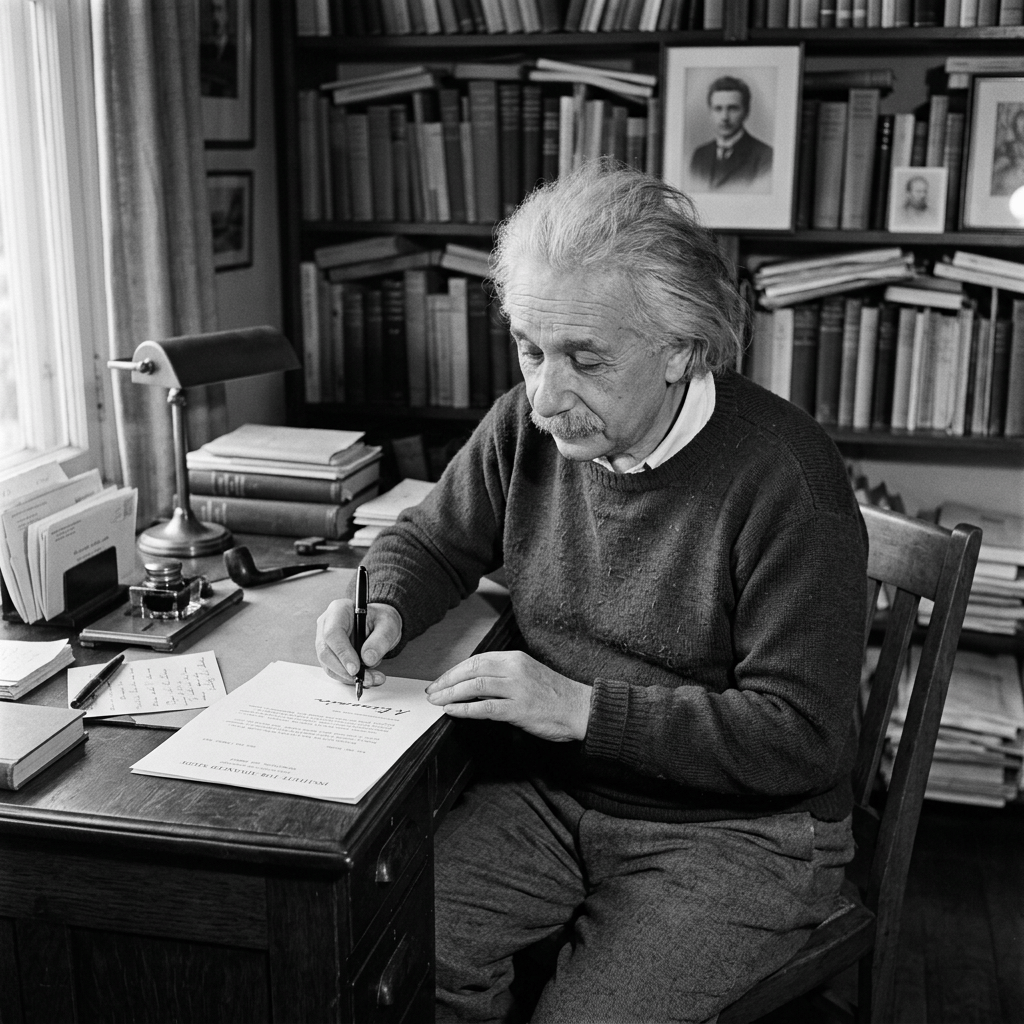
Within the framework of Evolutionary Anthropodynamics, Dr. Pronab K. Chowdhury justifies his characterization of Albert Einstein as a “bad politician” by contrasting his behavior with the
standards set by iconic leaders and by framing his political actions as transactional, hypocritical, and ultimately destructive.
The author provides the following justifications for this assessment:
- Failure of Self-Sacrifice and Moral Leadership
The author establishes a “model example” of a good politician by citing leaders like Mahatma Gandhi, Martin Luther King Jr., and Nelson Mandela, who were willing to face imprisonment
or death for their causes 1-3. He argues that Einstein, by contrast, lacked this courage:
● The 1933 Flight: Instead of staying in Germany to face the Nazi threat—an act Chowdhury compares to the sacrifice of the Indian sage Dadhichi—Einstein fled to the “comfort nest” of Princeton 4-7.
● Betrayal of Brethren: The author claims that if Einstein had stayed and potentially faced martyrdom, his global fame would have alerted the world to the Nazi danger years
earlier, potentially saving 60,000 Holocaust victims 7. By fleeing, Chowdhury argues, Einstein prioritized his own safety over his “evolutionary duty” to his people 4, 8, 9. - Catalyst for the Rise of Hitler and the Holocaust
A central and controversial claim in the author’s justification is that Einstein’s own political rhetoric served as a “catalyst” for the very atrocities he later denounced:
● Provoking Antisemitism: The author asserts that Einstein’s public Zionist advocacy and “tribal hatred” of ethnic Germans between 1914 and 1933 intensified a “positive feedback circuit” of antisemitism in Germany 6, 10-14.
● Fueling Nazi Propaganda: He argues that Einstein’s behavior provided the “impulse” that helped the Nazi party achieve the mass frenzy necessary for their rise to power 12, - Transactional and “Hedonistic” Opportunism
The author characterizes Einstein as a “hedonistic opportunistic intelligent professional” whose politics were driven by personal and financial utility rather than ideology 16-18:
● Politics for Funding: He describes Einstein’s 1921 US tour as a “processional” intended to use his manufactured “star scientist” status as a fundraising brand name for Zionist projects rather than a pursuit of political truth 19-21.
● “Bite as a Snake, Then Exorcise as a Healer”: Chowdhury uses this metaphor to describe Einstein’s involvement with the atomic bomb 22. He argues Einstein first acted as the “snake” by advocating for “genocidal weapons” in his 1939 letter to FDR, and then spent the rest of his life performing as a “pacifist” (the “exorcist”) to protect his humanitarian icon status 22-26. - “Divide and Rule” and Social Engineering
Chowdhury justifies the “bad politician” label by claiming Einstein employed a “Divide and Rule” strategy in America to secure the status of the Jewish elite 27, 28:
● Replacing Antisemitism with “Red Scare”: The author argues that Einstein’s 1949 essay “Why Socialism?” was a calculated move to redirect American hostility away from
the Jewish intellectual elite and toward communism, thereby replacing antisemitism with a “Six-phobia” (fear of reds/communists) to ensure the Jewish “Golden Age” in America
29-31. - Lack of Conviction in the State He Championed
Finally, the author points to Einstein’s behavior after the founding of Israel as proof of political shallowness:
● Detachment from Israel: Despite being the “founding father” and strategic brand name of the movement, Einstein never visited the State of Israel during his final years and
refused the offer to lead it, which the author interprets as a total lack of genuine political or ethnic devotion 32-35.
In summary, the author justifies his claim by portraying Einstein as a political performer who global crises and manipulate public sentiment for tribal gain while avoiding the personal risk and duty required of a true statesman 36-38

