
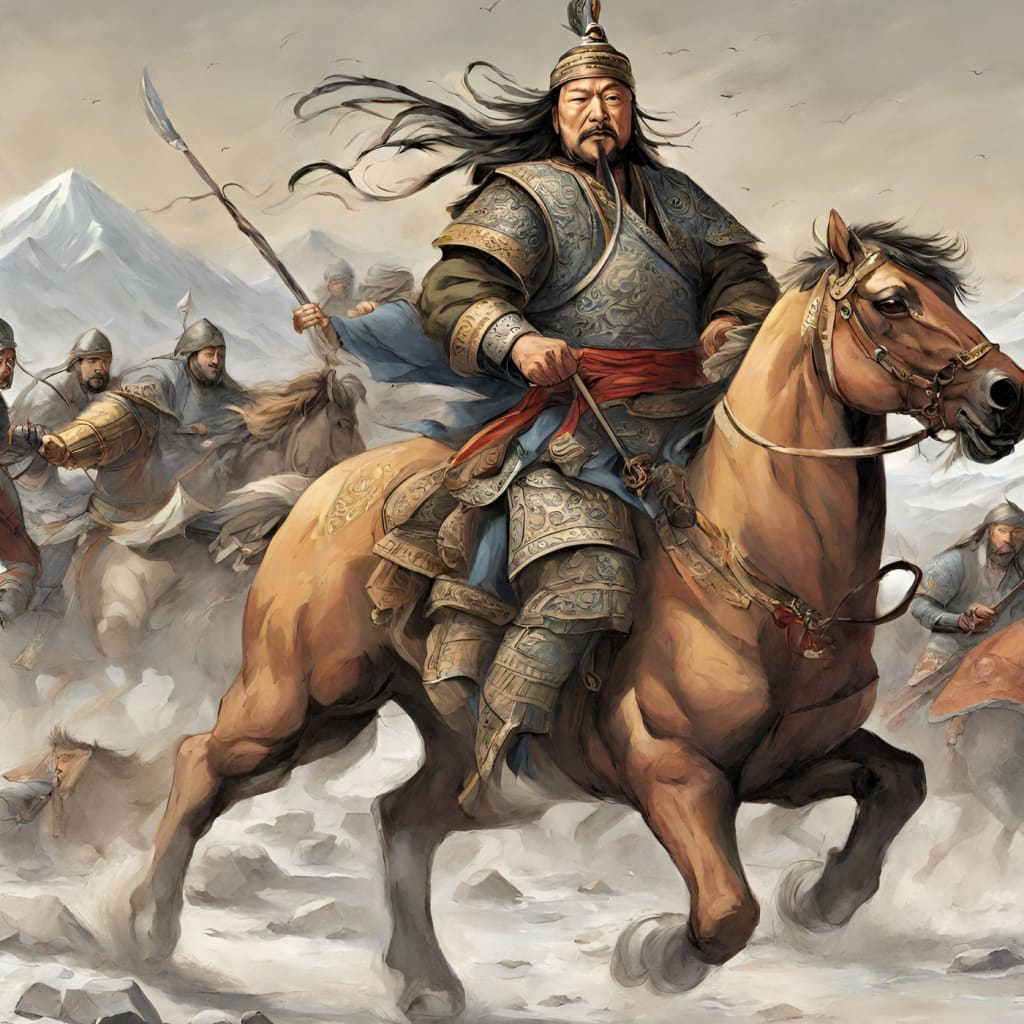
In the framework of Evolutionary Anthropodynamics, Dr. Pronab K. Chowdhury defines Gengish Khan syndrome as a specific type of “evolutionary sickness” or social instability that occurs when a previously fragmented population suddenly unifies into a single, culturally cohesive empire with aggressive expansionist ambitions 1, 2.
The author justifies and explains this syndrome through several historical and theoretical lenses:
- Historical Archetype: The Mongol Empire
The term is derived from the 13th-century unification of nomadic Mongolian tribes under Genghis Khan 3, 4. The author characterizes this original syndrome as the creation of a “wealth-plundering” system where a unified “volkish” population uses “military IQ” and superior strategy (a form of “IQ supremacy”) to extract resources from other nations rather than producing them 5-7. - Application to Unified Germany (1871–1945)
The author’s primary modern application of the syndrome is the unification of Germany in 1871 1, 3.
● Volkish Nationalism: Unification transformed disparate German-speaking states into a single “volkish” population with a unified language and culture 3, 8.
● Weltpolitik: This unification birthed an intense desire for world power and colonial expansion (Weltpolitik), which directly conflicted with the existing British and French
colonial empires 3, 9.
● The 75-Year Rule: Chowdhury argues that this “evolutionary instability” reached a terminal breaking point exactly 75 years after unification, encompassing the massive
destruction of World War I and World War II before the system collapsed in 1945 2, 10. - Characteristics of the Syndrome
● White Supremacy: In the context of 19th-century European empires, the author links the syndrome to the rise of white supremacist and expansionist mindsets, such as
“Manifest Destiny,” which he claims were “transmitted” across the Atlantic to fuel German aggression 11.
● IQ Supremacy: Just as the Mongols used military intelligence to dominate, modern
manifestations of the syndrome utilize technical, scientific, and financial dominance—what the author calls “IQ supremacy”—as a weapon of imperial control 5, - Connection to Albert Einstein
The author explicitly links Einstein to this syndrome by characterizing him as the “founding father” of a modern “IQ supremacy empire” 12, 13. - He argues that: ● Einstein’s scientific celebrity was used to unify a high-intelligence diaspora (the HIIHIQ population) into a borderless power structure 12, 14, 15.
● The author places Einstein “on the same level” as Genghis Khan, asserting that both founded imperial systems based on intellectual or functional dominance to extraction global wealth and influence political outcomes 12, 16.
In summary, Gengish Khan syndrome is portrayed as a destructive evolutionary process where the sudden arrival of a unified, high-intelligence power clashes with existing global
structures, leading to world-altering crises and “wealth-plundering” imperial systems 2, 3, 5.

